Pages

Showing posts with label Tunnels. Show all posts

Saturday, 19 January 2013

Faces of Plymouth Blitz

Over the past four years we have met with many locals who experienced the Plymouth Blitz, & this year we are looking to speak with more to gather stories & photos from the time. Our research will be collated as part of the Faces of Plymouth Blitz project we have running throughout the year & we urge you to get in touch with us if you would like to share your memories for future generations to learn more about their past.

One of our readers, Lucy, recently got in touch with some fantastic memories from her mum, Mary, whom we have since spoken with to gather detailed information of her experiences in WWII & shed more light on the deep air raid shelter at Hexton Tunnel.

Here is a short excerpt of the full account that Lucy kindly mailed us;


Mary Outhwaite (nee Hine) was born in January 1938, and lived on Hooe Road, the main road into Hooe, until she was an adult.  She remembers the Hexton Hill tunnel and the Breakwater fort.
When the air raid alarm started, my mother would pick me up take me to the bottom of the garden, over the fence, through the fields and down the steep path that leads to the tunnel.  At times the tunnel would be full of people, sometimes squeezed in like sardines – my mother said that one night it was so airless in there, a match wouldn’t stay lit - some of the people would have made makeshift beds.  Mother and I would often sit on some type of wooden bench until the all clear sounded, and we would go home.  There was no door at the entrance of the tunnel, and some people would stand and watch the planes and bombing.  My father wasn’t with us as he was in the home guard and stationed at the top of Murder Hill (Hooe Hill), where there is still a sentry box near the top on the left, where the ground starts to level out.  He was stationed on the guns there, I suppose firing at incoming enemy aircraft. 
My father used to rent a piece of land which overlooked the tunnel, and I used to play there.  When I was about nine or ten (after the war), I would visit the tunnel with friends and walk right through, although there was a slight kink in it and you couldn’t see daylight from one end to the other.  One day we could see a suitcase in the entrance to the tunnel, we didn’t approach, but went home briefly, probably ten minutes at the most.  When we came back, our picnic had been ransacked – oddly, the cheese pasties had gone but the rock buns remained; the suitcase had gone.  The tunnel is on the edge of Hooe Lake, local people were convinced that Lord Haw Haw, the famous propagandist, lived close by on a house boat, and was seen sitting in the bar of the Royal Oak which is also on the edge of the lake.  This may have been after the war although he was tried at Nuremburg and subsequently hanged. 
My grandmother, Mary Hine, realised that this steep track to the tunnel was not an easy one to follow in the dark, so she painted marker stones white to aid vision by night. I last went into the tunnel about ten years ago, from the lake side, it seemed so much smaller!  It was about five foot wide, and a couple of feet drop on either side of the main path.  It was being used for storage, and it didn’t go back very far.


A collapse in the tunnel today denies access to the other entrance that Mary's family used

There we have it, just one amazing story that we intend to build on & all thanks to one of our readers getting in touch to share their family history. If you would like to feature your family as part of the series, please get in touch via info@hiddenplymouth.co.uk


Keep following for future updates & amazing memories from the children of Plymouth Blitz. Here is a video from Steve Johnson showing an ITV documentary from 2001.


Friday, 14 December 2012

Plymouth's Lost Railways

As with any major city in the UK, former railways can be found with little effort & research. Lost to the decline in rail travel or modern developments, bridges, cuttings & old tracks now form a part of the urban landscape, enveloped by the need for more housing within the City boundary. Tales from forgotten tunnels, relics reclaimed by nature, with many a Janner having memories of places like Darkies in Devonport & Leigham AKA Cann tunnel. Stories of ghost hunts, a sneaky hideway for smoking cigarettes or snogging sessions with Angie Watsername have all surfaced during our research, but by far the biggest myth has to be the one that there is a tunnel full of locomotives, secretly hidden away & preserved in tip top condition!

An overgrown portal of one of Plymouth's forgotten railways

Granite sleepers bearing the grooves from the  once busy Plymouth & Dartmoor Railway
Part of The Plymouth Great Western Docks Railway remain to this day, the two buildings have now been demolished

Sleepers lie covered in moss - a reminder of what this cutting once was

Overgrown railway platform - imagine this as a once busy scene with the smell & sound of steam trains


Along the way we will feature some of the lost railways including the London & South Western Railway, Plymouth & Dartmoor Railway, Great Western Railway, Friary & Millbay Stations plus much more. From horse-drawn carrriages on narrow gauge rails to the days of the steam engine & beyond to diesel locos. Imposing viaducts, old station buildings & bridges of architectural importance lost to vast swathes of progress since the war, replaced by the expansion of housing & commercial properties.

Looking toward the former Ford viaduct that was demolished in the 1980's

Hooe Lake Swing Bridge - a stark remnant from the Turnchapel Branch Railway

Stonehouse Pool Viaduct

Another view of Stonehouse Pool Viaduct with Pennycomequick Viaduct in the background

Great Western Railway boundary marker


These former remnants of travel & transportation carry thousands of stories - from the people who designed & built them, the people who travelled on them or the childhood memory of watching locos during summer holidays. Journey's to the fringes of Dartmoor or seaside towns such as Looe were a common day out for families for years as was the transportation of thousands of troops, & we are looking for your memories & photos to add to the existing archive we have built, to keep the history of these once important structures alive. Get in touch with us via info@hiddenplymouth.co.uk


An extremely rare sleeper from the Plymouth & Dartmoor Railway
Pitch black - Darkies
Lost & forgotten
A remnant of the last rails to Kings Road
Seeking refuge in the shadows
Alien like formations now adorn long forgotten tunnels

We have been tracing these lost routes for the past 6 years - from Plymouth to Tavistock, Dartmoor & Yealmpton & the industries they served such as quarries & mines. The website will feature these routes in more detail but we will keep you updated on the blog for follow-up research that is constantly ongoing.

If you have any memories or photographs of old railways & transportation in Plymouth, we would love to hear from you - info@hiddenplymouth.co.uk


Monday, 5 November 2012

Palmerston's Follies

Whether out on a boat in Plymouth Sound, walking the coastal path around Mount Edgcumbe or driving along the A38, you're not too far away from one of Palmerston's Follies, but what exactly are they & what were their purpose?

Hidden-Plymouth-Forts
Picklecombe Fort on the Western Approach of Plymouth Sound


A ring of Victorian era defences surround Plymouth in the form of impressive looking forts & gun batteries, with some sites being remodelled from earlier Napoleonic fortifications. Those built within the era of the Prime Minister at the time, Lord Palmerston, came about after fears of a French invasion as reported in the 1860 Royal Commission on the Defence of the United Kingdom. Lord Palmerston championed the idea of strengthening coastal defences & harbours around the UK. It was a costly exercise - the greatest ever spent on building fixed defences during peacetime, & by the time of completion, advances in gun technology had rendered the forts out of date. Hence they became known as Palmerston's Follies.

Hidden-Plymouth-Palmerston-Forts
Tregantle Fort - Still in active military use as a firing range


The Plymouth Defences were built with intention of defending the threat of a Naval assault by the French on Plymouth Dockyard. Any modern visitor to Plymouth via sea will often ask the question of what structures they are seeing as they enter Plymouth Sound. Picklecombe Forts lush apartment conversion greets visitors as they reach the Breakwater, where once inside, the impressive dark & daunting look of Breakwater Sea Fort & the mighty combined fortifications of Bovisand & Staddon Battery at Staddon Heights can be seen at their best. Further inland, Stamford & Staddon Forts complete the south-eastern side Reaching Drake's Island, Palmerston era additions can be seen in the form of an arc of stone casemates with protective iron shields that housed twenty-one 9 inch guns.

Hidden-Plymouth-Palmerston-Forts
Breakwater Fort

Hidden-Plymouth-Palmerston-Forts
Fort Bovisand & the earlier Staddon Heights Battery

Hidden-Plymouth-Palmerston-Forts
Drake's Island Casemates


Plymouth's Northern Defences stretch from Efford Fort all the way to Ernesettle Battery overlooking the Tamar. Sandwiched roughly in the middle is Plymouth's best preserved Palmerston, Crownhill Fort which is now utilised by businesses & wedding venue with occasional open days to the public. All of the Northern Defences are occupied with businesses or Plymouth City Council in-situ with the exception of Ernesettle Battery which is MOD, & Agaton which is a VOSA Test Station.

Efford Fort to the left overlooking the North Eastern Approaches

Cannons in-situ at Crownhill Fort

Murder Hole Ditch at Efford Fort being reclaimed by nature

Agaton Fort Gatehouse - No Access


On the Cornish side around the Rame Peninsula, coastal gun batteries & forts snake the coastline from Garden Battery at Mount Edgcumbe to Scraesdon Fort at Antony & although some were lost to demolition in the 1970's, there has been excellent works to preserve their status from current tenants who look after the structures including the Rame Conservation Trust, Mount Edgcumbe Estate, Defence Estates, Ministry of Defence & all the owners of converted sites such as Cawsand, Picklecombe & Polhawn Forts & Whitsand Bay Battery which is now a holiday park.

Hidden-Plymouth-Palmerston-Forts
Scraesdon Fort from above

Hidden-Plymouth-Palmerston-Forts
The grand stone entrance to Tregantle Fort

Hidden-Plymouth-Palmerston-Forts
Flooded moat at Scraesdon Fort

A handful of forts have suffered vandalism & theft in recent years including Bovisand & Drake's Island, which had renovation & refurbishment projects put on hold due to the recessions, but recent rumblings on the grapevine are positive & look good for the future. One things for sure If we won the lottery jackpot, we would certainly offer to buy it straight from the owner & reopen it to the People of Plymouth....a name? ooooh maybe Cultural Adventure & Heritage Centre of Plymouth....or is it forward thinking enough for the Plymouth vision of a modern city?......school trips, tourism, local produce brought to the island by boat, open days, jobs with old trade skills brought into much needed use....must...stop....dreaming! Oh & did you know that Drake's Island is actually the cap of an extinct volcano? Awesome history that Plymouth has don't you agree?

Thankfully some of the forts have been much better cared for & the conversions to apartments & holiday homes at Cawsand & Picklecombe Forts are stunning. Okay, so they may be a little out of our price range & we can't even afford a second home but we still appreciate their history & the imposing look these structures have. Polhawn Fort is now primarily a wedding venue, a place we considered for our own wedding, & in our opinion this has to be one of the best wedding venues in the South West. The time, money & priceless effort that has gone into the restoration of the fort is phenomenal & we will feature this in a forthcoming series on the blog.

Hidden-Plymouth-Palmerston-Forts
Inside one of the immaculate bedrooms - Polhawn Fort

Hidden-Plymouth-Palmerston-Forts
TV replaces the cannon - note the original racer rail for the cannon

Hidden-Plymouth-Palmerston-Forts
One of my favourite spiral staircases - stunning workmanship


Over a series of blog posts, we will take a look at each site in detail, including the demolished gun batteries around Plymouth & the surrounding area. A strong focus point of our research will be to build a history of Military Units & stories from personnel who have their own memories of a particular site & we welcome any information of historic value. Graffiti from years back adorn many of the forts with units such as the Royal Marines, Royal Engineers, The Parachute Regiment & even the SAS. Feel free to get in touch if you recognise any of the graffiti featured in the forthcoming gallery - info@hiddenplymouth.co.uk

Hidden-Plymouth-Palmerston-Forts
1939 graffiti from a Commando veteran

Hidden-Plymouth-Palmerston-Forts
Until next time....another spiral staircase in a Plymouth Fort - we're off to see what's down there


Tuesday, 25 September 2012

"The Wall" Public Air Raid Shelter Part 2

Well you got the brief tour of the "The Wall" ARP Shelter & here we look at some of the graffiti & artefacts found within alongside a few surprises above ground. To kick off though, we want to focus on that one brick in "The Wall".

P.L.D. 10 Years 13/1/1941 


The person who etched this into the brick toilet cubicle would now be 81 years old & we are guessing it is a male. We urge all readers to check their families for the initials & help to identify the writer. Hey, we know it's a long shot but we like to search really deep for our research & build a better history for the shelters that form an important part of our heritage. We have tracked a family from other graffiti in the past, one being from the Devonport Park shelter that was partly demolished back in 2009. Writings in this shelter have given us some leads to work on including an address in Mount Gould Road.


The best we have to go on!

Any takers on this one?

Inscription found in another toilet block

One of two face drawings found close to each other

Face art

Character drawings

Mister Sad

Basketball?

Striking chin feature in this drawing

Contractor says fire engine, archeaologist says bus, we say it's a tram - How about you? Send us a comment below!

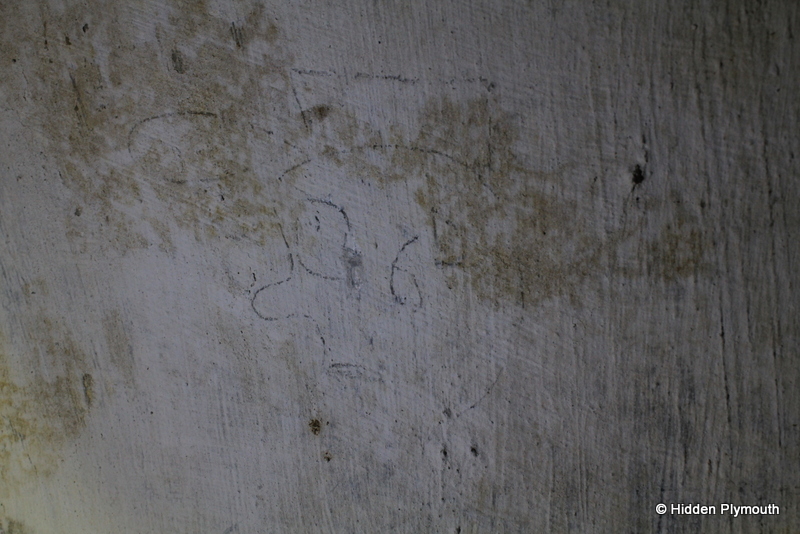
Although there was little graffiti, it was some of the most interesting. Clearly there were signs that the shelter had been whitewashed with a second coat at some point due to the way that some of the pencil markings were showing through & again highlights just how clean this shelter was. Whoever was in charge of it certainly took pride in it's appearance. Thankfully there were just a few artefacts that were left behind at various points along the underground passageways.

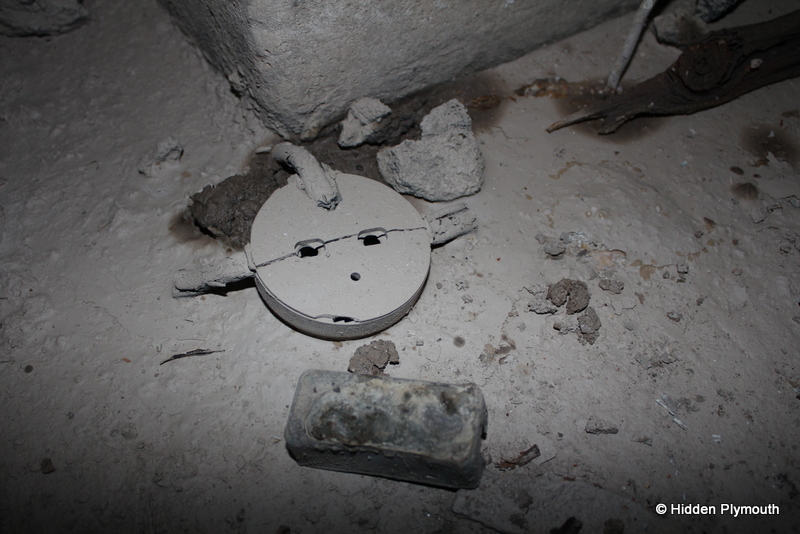
Artefacts found close to the entrance

Rusted, almost disintegrated bucket

Bottles from the wartime era

Bottled in Exeter

Bakealite junction boxes for electric lighting

Bench fixings void of timber seats

Bakealite fittings

Now personally for me, apart from the etched brick, the highlight was what the shelter was cut into above ground. Evidence of the Plymouth Leat was what the archeaologist's were said to be looking for & also the original cobbled surface of the car park had been revealed as see in the photos below. This shows how sympathetic the demolition has been of this shelter, a behind the scenes look at how little damage was done to the original structure itself. An escape hatch had been exposed & there were a couple of exploratory holes cut through the roof, but most impressive was the stairwell that had been throughly cleaned by contractors in preparation for the documentation to take place. 

This was always one of those shelters that would be demolished due to the need for development within the city centre, but at least it has been documented in a way that Plymothians can now see for themselves that it is not always wanton destruction of heritage. We were impressed with how thoughtful the contractors & Uni staff were toward the shelter & taking time to tell us their views on it's existence. A lot of people thought that this shelter was long demolished since the war, & it's highly possible that this was just infilled quickly & re-tarmaced before the end of the war & returned to it's use as a car park but, with all the madness of rebuilding the blitzed city it's highly possible that documents were lost along the way.

Stood atop the entrance to the shelter with Plymouth Museum in the background
Entrance overlooked by the Link & Davy Building

A different angle over the entrance

Original cobbled road that the shelter was constructed through

Stood on top of the shelter showing depth, cobbled road & contractors exploratory hole

Close up looking the cobble surface
Stood with our back to the previous image looking midway along the shelter & exposed escape hatch

Shelter looking toward the infilled end - notice the stone walls that the shelter has cut through

This section of the shelter cut through some sort of stone walling - could this be a trace of the leat?
Surveying the site stood atop the section that had yet to be uncovered fully above ground

There it is & we also made a short video tour of the shelter which will be uploaded soon for you to follow the passageways to the end. On a personal note this was an excellent shelter to document with the different layers of history around it & particularly pleased to see how the passageways cut though the cobbled road.

A lot of feedback has been received since the first photos appeared & we welcome feedback from as many people as possible, after all it is your support that will eventually lead to one of these time capsules to be saved. As we have already mentioned, many people had thought this one had long gone years ago so with the groundworks for a much needed new University building imminent, it would have suffered major setbacks if the shelter were to be kept & plans changed to adapt. Given better hindsight, if it could have been integrated into the new building as a permanent historic feature it would certainly have been one of the most interesting campus buildings in the world, food for thought!